Why Your Small Business Social Media Isn’t Growing (And the Marketing Fix That Works)
1. The uncomfortable truth: you’re not “bad at social” — you’re posting like a brochure
If your small business marketing social media isn’t growing, it’s usually because your posts are built like ads:
Product photo + shop now
service graphic + now booking
a list of features nobody asked for
"we're passionate about.." (your audience does not care yet)
And people are neurologically trained to ignore ad-shaped content. Estimates commonly put daily ad exposure in the 6,000–10,000 ads/day range. And “banner blindness” (people automatically tuning out ad-like visuals) has been measured at 86% in an often-cited study.
On social feeds, the time window is brutal, you get a tiny window to earn attention - stats peg scrolling speed at ~2.5 posts/second, meaning you’ve got roughly 0.4 seconds to trigger a stop.
So the fix isn’t “post more.”
The fix is: stop posting like you’re asking for money. Post like you’re giving people a win.
-> If your marketing feels scattered, start with this 14-day reset
2. The 5-minute “ad-shaped post” audit (steal this)
Open your last 9 posts and score them fast. If your post contains 2+ of these, it reads like an ad:
A clear “buy/book” CTA with no context
A product/service shot as the main idea
Generic benefits (“high quality”, “premium”, “results”)
Feature lists without a decision (“X pages, Y material… so what?”)
Heavy branding / brochure design
“Limited spots” as the hook (instant skip for skeptical buyers)
The fix: Lead with payoff. Earn the CTA.
Payoff-first formula: Pain they recognize → consequence → payoff → proof → next step
Example:
Pain: You’re overwhelmed trying to choose the right ___, and you’re scared of wasting money on the wrong one.
Consequence: So you keep researching, keep asking friends, keep putting it off… and the problem doesn’t go away.
Payoff: Here’s the simple way to pick the right ___ in under 60 seconds (without needing expert knowledge).
Proof: Use this quick checklist/guide, it’s the same one my customers/clients use to make the right call the first time.
Next step: Save this and use it today: If you want ___, choose ___. If you want ___, choose ___.
This is how social media marketing for small businesses becomes a system, not a slot machine.
3. Stop leading with your offer — lead with payoff
People follow accounts that reliably deliver one of these payoffs:
Help me decide (reduces uncertainty)
Help me avoid mistakes (reduces risk)
Show me proof (reduces skepticism)
Give me a shortcut (reduces effort)
Say the thing I’m thinking (makes them feel understood)
That’s it. Your job isn’t to “show up.” Your job is to create Stop → Stay → Signal:
Stop: a hook that speaks to a real problem
Stay: one clear idea (not 12 tips)
Signal: a reason to save, send, comment, DM
If you don’t design for signal, the platform gets a clean message: scroll = not interesting.
4. The 6 post types that actually grow small business accounts in 2026
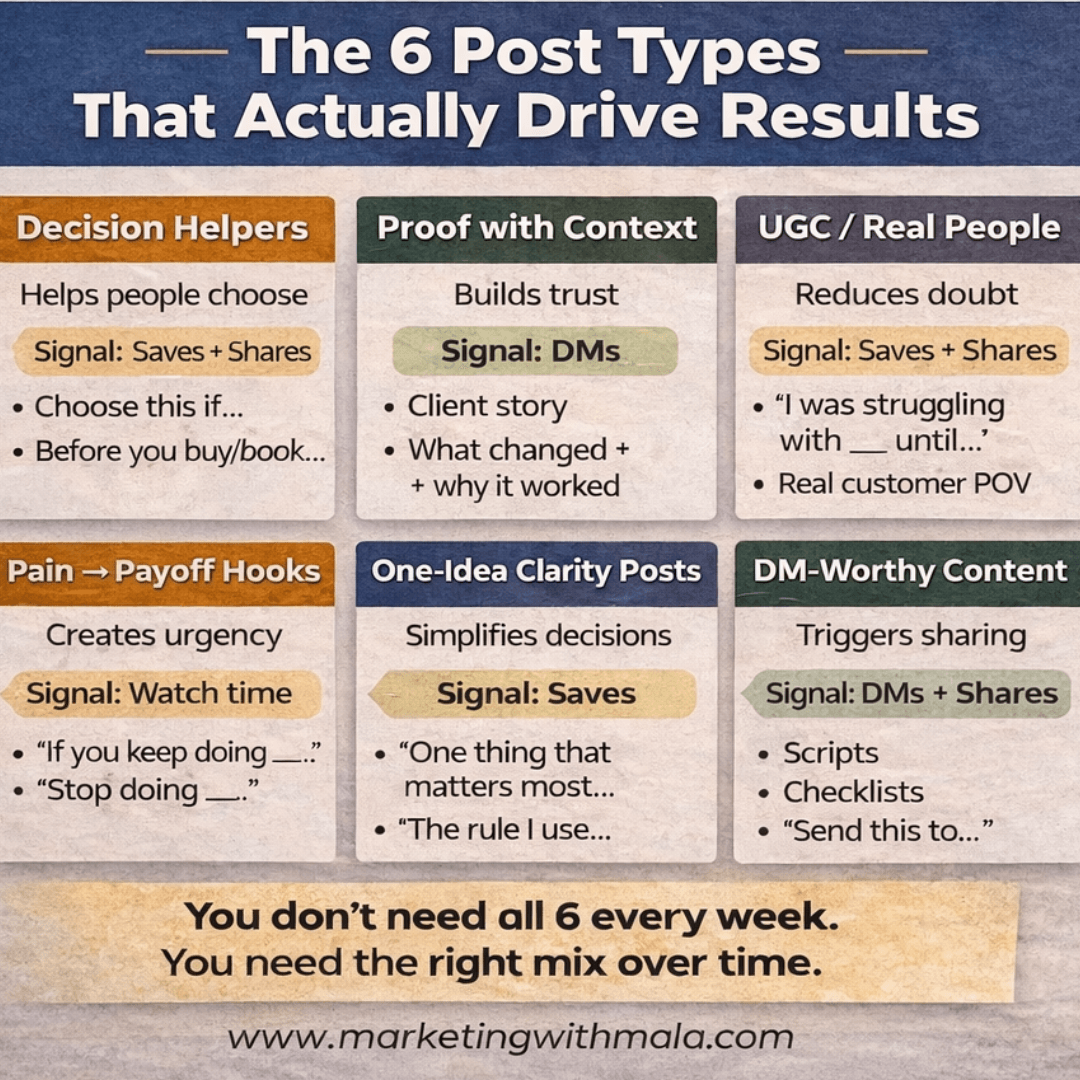
Post Type 1: Decision-helper posts
What it is: A vs B, “buy this if…,” “avoid this if…,” “3 red flags,” “what to ask before you book.”
Why it works: Saves and shares go up because you reduce uncertainty.
Copy-paste hooks:
“Before you buy ___, decide this first (or you’ll waste money).”
“A vs B: choose A if you want ___. Choose B if you want ___.”
“If you’re about to book ___, ask these 3 questions (or you’ll overpay / get the wrong outcome).”
Make it instantly usable (structure):
The decision (one decision only)
The 2–4 filters
A 10-second example
Signal CTA:
“Save this, next time you’re about to ___, use it.”
Post Type 2: Proof with context (stories > testimonials)
What it is: A result + the “why it worked” + the lesson.
Why it works: Generic testimonials are wallpaper. Context makes proof believable.
Copy-paste hooks:
If you’ve been trying ___ and it’s not working, this is the part you’re missing (client story)
A client asked me ‘is it normal to ___?’ Here’s what we did and what happened
He thought the problem was ___. It wasn’t. It was ___.
What to include:
What the situation looked like before
What the customer/client changed (one change)
What improved (even if it’s small)
If you don’t have testimonials or a big win yet: use micro-proof
Screenshots of customer questions you keep getting
A mini case: “what we learned from 20 customer DMs”
A behind-the-scenes fix you made for yourself/your business
CTA:
DM me if you want similar results
Save this if you want the same outcome without trial-and-error.
Post Type 3: Feed-native UGC / “real people” proof
What it is: Customer clips, unboxings, real photos, voice notes, screen recordings, “day in the life,” etc.
Why it works: It collapses trust friction fast: “people like me did this.”
If you don’t have UGC yet (do this anyway):
Ask 3 customers: “Can you film 10 seconds answering why you chose this?”
Or create Founder-UGC: you on camera showing the product/service in use with a real story.
Copy-paste hooks (customer perspective/voice):
I kept buying ___ and getting disappointed. This one was different because ___
I didn’t want anything ‘fancy.’ I wanted something that actually works in real life
I’ve been using it for ___ days and here’s what changed
I almost didn’t book ___ because I thought ___. I’m glad I did
Signal CTA:
If this sounds like you, save this.
Send this to a friend
Post Type 4: Pain → consequence → payoff hooks (open a loop)
What it is: A hook that names the frustration, shows the cost, then promises relief.
Why it works: Your target customers doesn’t need motivation. They need clarity and proof.
Copy-paste hooks:
If you keep doing ___, it’s going to keep creating ___ — even if you’re ‘trying hard’.
If you’re overwhelmed by ___, stop adding more. Remove this one thing first: ___.
If you keep buying ___ and it keeps failing, it’s probably because ___
“If you’re stuck at ___, stop doing ___ (do this instead).”
Keep the post tight:
One painful truth
One simple fix
One example
Signal CTA:
Save this if you keep getting stuck on ___.
DM ‘START’ if you want a simple next step for your situation.
Post Type 5: One-idea posts (clarity beats volume)
What it is: One strong idea, one angle, one takeaway.
Why it works: Completion goes up. Saves go up. People don’t feel overwhelmed.
Copy-paste hooks:
If you’re buying ___, this one thing matters more than everything else: ___
Stop choosing ___ based on ___. Choose based on ___
The easiest way to pick the right ___ in 10 seconds
One thing people wish they knew before buying ___
Signal CTA:
Save this. Do it once this week. Then come back and tell me what happened.
Send this to someone who keeps overthinking ___
Post Type 6: DM-worthy content
What it is: scripts, checklists, warnings, shortcuts, “say it like this” posts.
Why it works: People share what makes them look helpful to someone else.
Copy-paste hooks:
Steal this checklist so you don’t waste money on ___
Here’s what to ask (or check) before you buy ___ online
Here’s the quick-size/fit/option guide people keep DMing me for
If you hate ___, do this instead (and send it to someone who complains about it)
Signal CTA:
DM me/us for the checklist/guide/answer ___
5. The repeatable 4-post week (simple, realistic, effective)
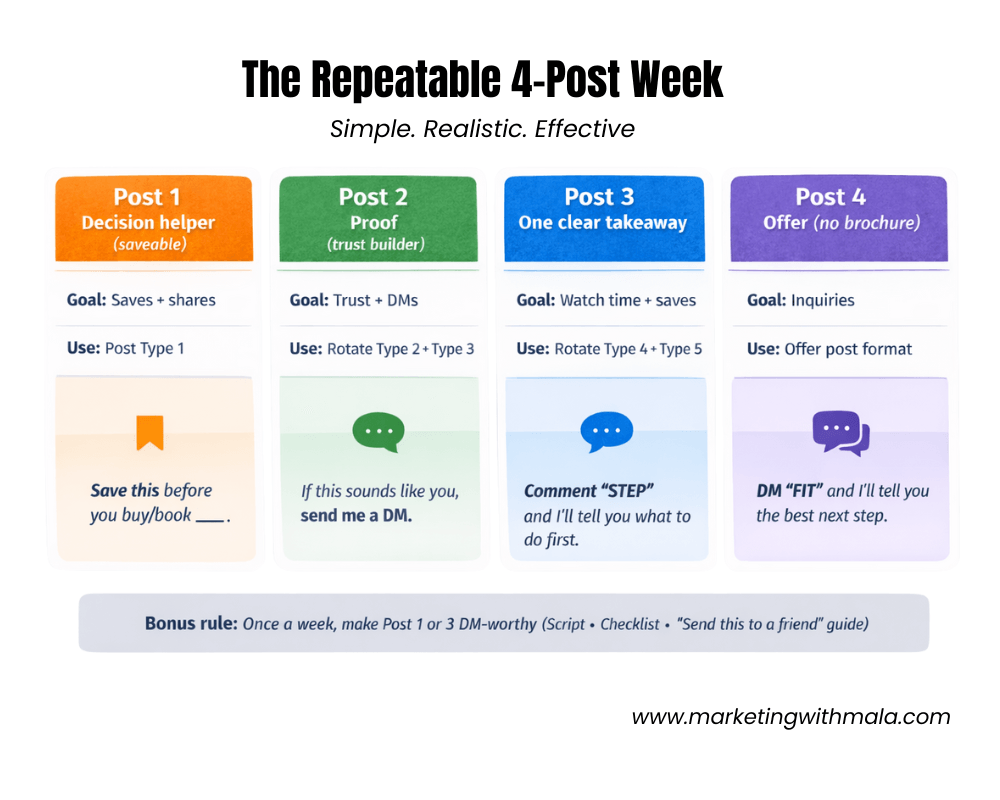
You don’t need 30 content pillars. You need a weekly rhythm that trains your audience to expect value:
Post 1 — Decision helper (saveable)
Goal: saves + shares
Use: Post Type 1
Post 2 — Proof (UGC / testimonials with context)
Goal: trust + DMs
Use: Rotate Post Type 2 + Post Type 3 (alternate weekly)
Post 3 — One-idea hook post (retention + clarity)
Goal: watch time + completion + saves
Use: Rotate Post Type 4 + Post Type 5 (alternate weekly)
Post 4 — Offer post (clear CTA, no brochure)
Goal: inquiries
Use: Your offer post format (who it’s for → problem → what happens next)
Add-on: Borrow a Post Type 6 CTA (“DM ‘___’ and I’ll send ___”) when relevant
6. The tiny scoreboard (so you stop judging by likes)
Most founders quit because they can’t tell what’s working.
Track these weekly (10 minutes):
Saves per reach (did it help them decide?)
Shares/sends per reach (did it feel socially useful?)
Profile visits per reach (did it trigger curiosity?)
DMs/inquiries per week (did it create action?)
Link clicks (if relevant) (did it move intent?)
What “good” usually means
If saves/shares are rising, your content is useful (keep going).
If profile visits rise but DMs don’t, your bio/offer/CTA is unclear.
If nothing moves, your hooks are too polite or too generic.
7. FAQs
How often should I post for small business marketing on social media to work?
Start with 4 posts/week using the structure above. Consistency beats volume. If you can only do 3, do: decision helper + proof + offer.
Do I need Reels to grow?
No. But you need retention somewhere. A Reel or a carousel that people actually finish.
What if I don’t have testimonials or UGC yet?
Use founder-UGC and micro-proof:
customer questions
behind-the-scenes fixes
screenshots of outcomes or feedback
Why do I get likes but not sales?
Likes are cheap. Social is only one part of the engine. Sales require:
clear message
clear next step
proof + trust
a conversion path that doesn’t leak
8. Want your full marketing system built in 6 weeks?
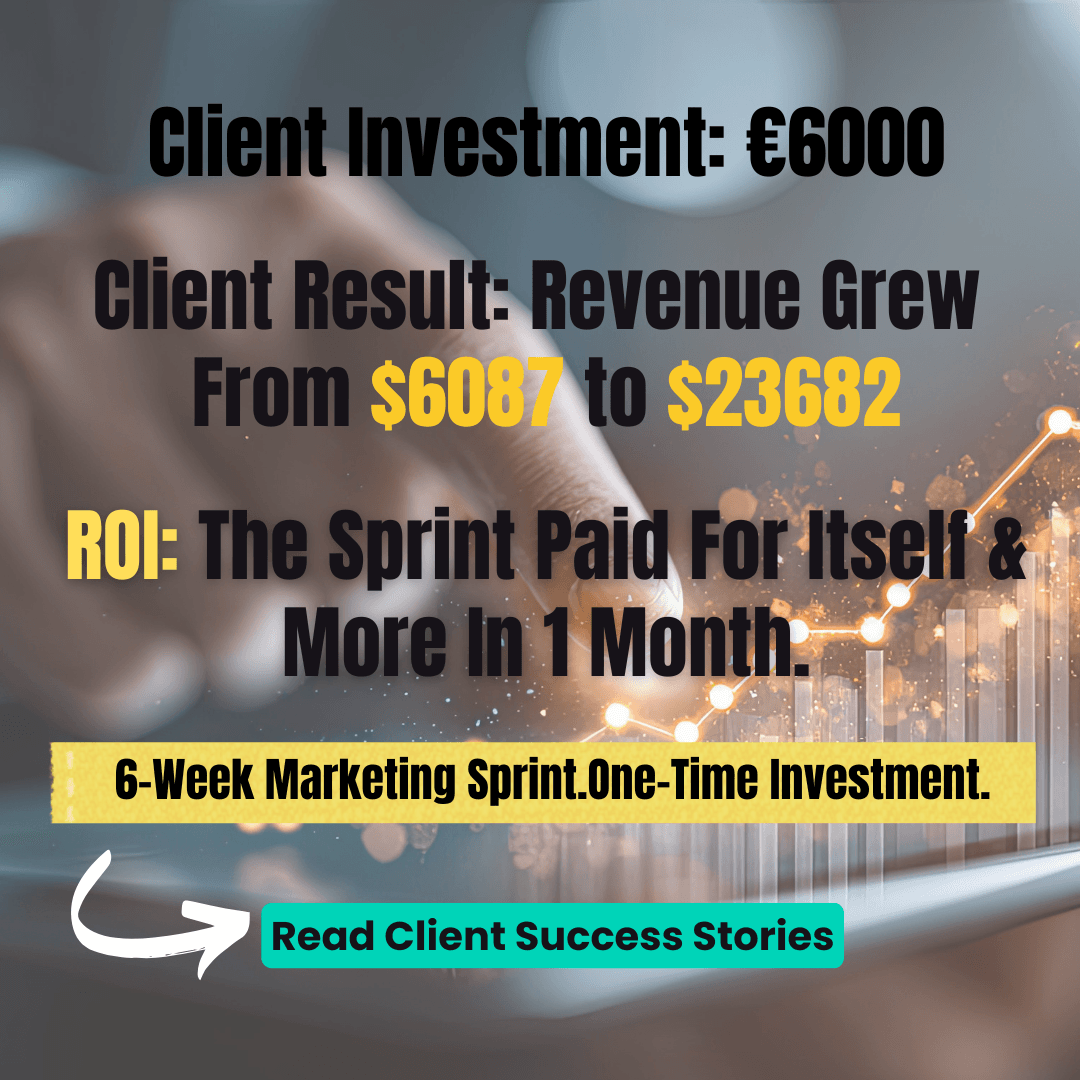
The truth: better posts help. But the founders who hit consistent revenue don’t “do social media.” They run an engine.
That’s what I build inside my 6-Week Marketing Sprint (one-time fee: €6,000):
Week 1: messaging + positioning + buyer psychology + conversion-first page plan
Week 2: SEO keyword map + on-page SEO + blog outlines + a 4-week social strategy + UGC scripts and outreach
Week 3: lead capture + a 5-email welcome sequence + recovery flows + segmentation + automations
Week 4: Meta ads system built from your messaging (setup, tracking, launch, creative direction)
Week 5: Google Ads search campaigns + GA4 setup + clear reporting so you know what’s working
Week 6: optimization + scaling rules + weekly/monthly routines + troubleshooting + a 60-day growth roadmap
So you stop cycling through tactics and start running a marketing engine that compounds.
Next step: Visit the 6-Week Sprint page and hit 'Apply' (no commitment at the apply stage).

About Me
Hi, I’m Mala. If you’re tired of trying “all the marketing” and still not seeing consistent sales, you’re in the right place. I bring 20 years of marketing experience (plus building/exiting my own ecom brand) to help you simplify, focus, and get to consistent 20k months.
Get the Weekly Fix
Short, practical small business marketing advice for founders who are tired of guessing. No hype. No spam. Unsubscribe anytime.

MarketingWithMala
Contact: info@marketingwithmala.com
© 2026 MarketingWithMala